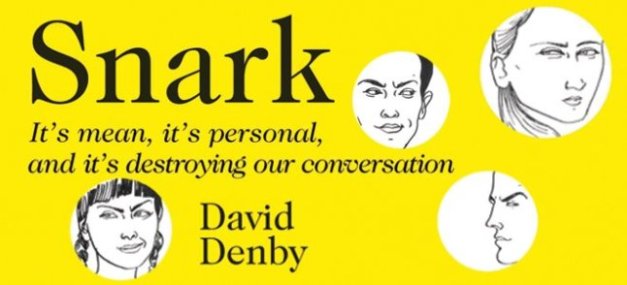
Hugo Rifkind challenges Denby's analysis of snark in his recent review:
"Snarking online bothers Denby mainly because of its anonymity. He finds it, he writes, redolent of the start of The Trial by Kafka — “Somebody must have slandered Joseph K., for one morning, without having done anything truly wrong, he was arrested” — but I suspect this is because he takes snark altogether too seriously. “Why hide behind a handle?” he asks. “The answer, of course, is that the anonymous writers are either ashamed of what they’re saying, or , alternately, quite proud of what they’re saying, but in either case they’re not eager to confront anyone directly.”
Exactly wrong, I’d say. Your classic snarker is neither proud of the substance of their message nor ashamed of it, but entirely indifferent to it. They care only about the joke. Anonymity lets you enjoy the clever words without having to worry about being taken to task for their meaning. That’s snark all over. It’s this emptiness — the essential glibness of snark — that Denby can’t seem to grasp. He wants snarkers to have motives, and they don’t."
Do snarkers have motives?
Showing posts with label Hugo Rifkind. Show all posts
Showing posts with label Hugo Rifkind. Show all posts

Is the UK immune to snark?
Britain is too cynical to be troubled by snark, according to Hugo Rifkind in The Times.
"...not much snark in our papers, however hard you look. Nor on television, aside from Have I Got News For You? (although Jeremy Paxman sometimes comes close). And yet our conversation, day to day, oozes with the stuff. To bitch, to gossip, to backstab, to slag off, to unfairly lampoon — this is the essence of basic British chat. Indeed, when our public figures get in trouble for their jokes, this is invariably the result of habitual, insensitive conversational snark spilling over into the public sphere, where we don’t think it ought to be. Think of Jeremy Clarkson describing Gordon Brown as a “one-eyed Scottish idiot”, or David Cameron ridiculing ID cards by adopting a German accent, or Jonathan Ross and Russell Brand getting carried away on the radio, or Gordon Ramsay likening an Australian TV personality to a lesbian pig. Think of the Duke of Edinburgh, over and over again...
...So now you know. That’s snark. Is it coming here? Could be. But maybe pious, wholesome America was particularly vulnerable to this epidemic. If, as Denby says, snark is “spreading like pinkeye through their national conversation”, maybe that’s because the American national conversation didn’t see it coming, and is mesmerised by what it can do. But here, in sly, knowing, cynical Britain, I suspect that what they call snark has been the bedrock of our national conversation for years. Yeah. We’ll be fine."
Will we?
Subscribe to:
Posts (Atom)

 Posts


